Surgical Treatment · Lumbar spine

Lumbar Spinal Fusion

Lumbar fusion corrects alignment, decompresses compressed nerves, and stabilises the affected segment. Used when keyhole and minimally invasive options are not feasible.

Lumbar Spinal Fusion — treatment

What the procedure is

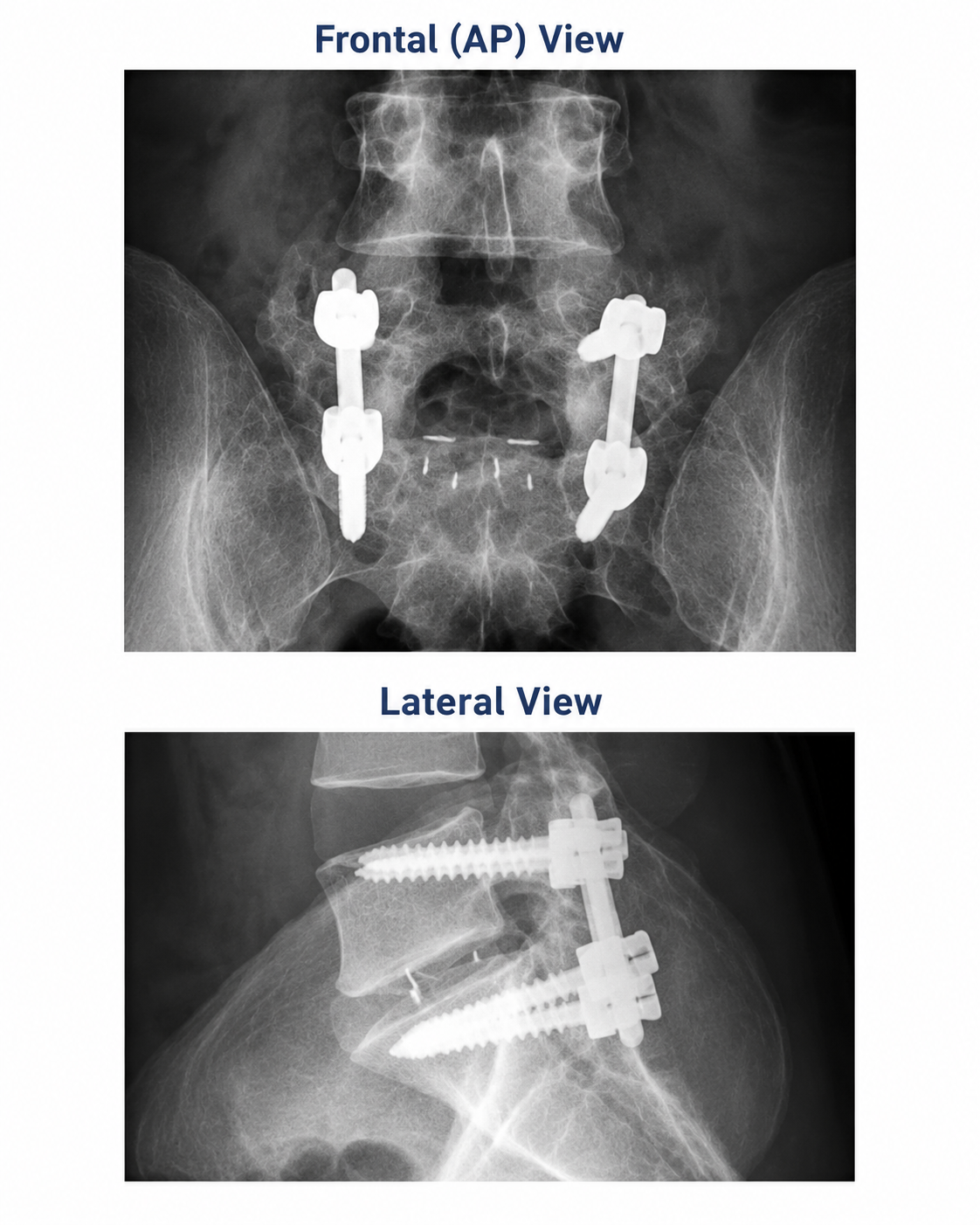
Lumbar fusion corrects spinal alignment and decompresses the affected nerve roots, then permanently joins the involved vertebrae using pedicle screws, rods, and bone graft or a cage. It is most often performed for spondylolisthesis — where one vertebra slips forward on the one below — but is also used for spondylosis, degenerative disc disease, and to prevent further slippage when the segment is unstable.

On the day

Lumbar fusion is performed under general anaesthetic and typically requires a 1–2 day hospital stay. Mr. Rath uses intraoperative imaging guidance to place screws with precision. Minimally invasive tubular techniques are used where the anatomy allows, reducing muscle damage and blood loss.

Physiotherapy begins the day after surgery to help you mobilise safely.

Why Mr. Rath's approach

Fusion surgery carries a high degree of technical complexity. Mr. Rath performs robotic-assisted and fluoroscopy-guided fusion, achieving accurate implant placement while minimising revision risk. We plan each procedure based on dynamic imaging to understand the full extent of instability before surgery.

Risks and considerations

  • Adjacent segment degeneration over years
  • Non-union (pseudarthrosis) — rare with current techniques
  • Implant-related issues (rare)
  • Infection and wound complications
  • Neurological risk (very low with experienced hands)

Mr. Rath will only recommend fusion when keyhole and minimally invasive options are not feasible for your particular anatomy, and when the imaging clearly supports intervention. All patients are thoroughly counselled before surgery.

Recovery timeline

  1. Day of surgery · 1–2 days

    Hospital admission for pain management and initial mobilisation with physiotherapy.

  2. Week 1-2 · 2 weeks

    Discharge home with pain medication. Short walks on the flat. Avoid prolonged sitting.

  3. Week 3-6 · 4 weeks

    Gradual increase in activity. Physiotherapy begins around week 4 to rebuild strength and conditioning. Return to desk work typically around week 4–6.

  4. Week 6 onwards · 3–6 months

    Phase-wise return to normal activity guided by Mr. Rath at the 6-week review. Bone fusion consolidates over 3–6 months.

Frequently asked
Is lumbar fusion a major operation?

It is a significant procedure with a longer recovery than decompression alone. Mr. Rath uses minimally invasive approaches where anatomy allows, reducing hospital stay and recovery time.

Take the next step

Discuss this treatment with Mr. Rath.

Online and in-clinic consultations available across the North West.

Book Appointment