Condition · Lumbar spine

Bertolotti's Syndrome

An enlarged transverse process at L5 that partially fuses with the sacrum, causing mechanical low back pain. Frequently under-diagnosed — learn how Mr. Rath approaches it.

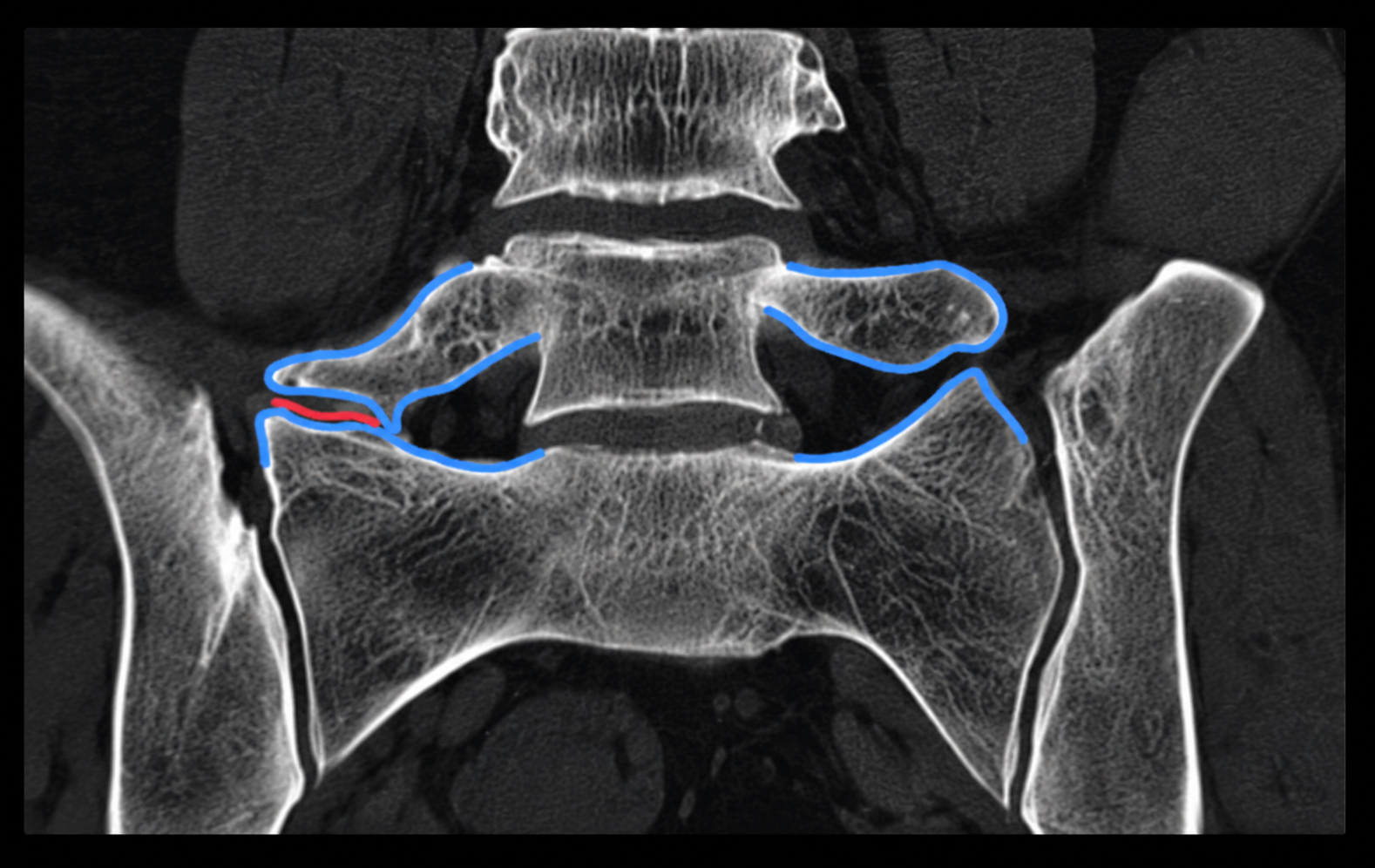
Bertolotti's Syndrome — anatomical illustration

What it is

Bertolotti's syndrome is caused by an enlarged, elongated transverse process at the L5 vertebra that forms a pseudo-joint with the top of the sacrum or iliac wing. This anomaly is a transitional variation of the lumbosacral junction, present in roughly 4–8% of the population. The abnormal joint creates a mechanical pain source that is poorly responsive to standard back pain treatments, leading to years of misdiagnosis for many patients.

How it's diagnosed

The key steps to diagnosis are:

  • Plain X-ray or CT scan to visualise the enlarged transverse process and its articulation
  • Classification of the anomaly (Castellvi type I–IV) to guide management
  • A diagnostic injection directly into the anomalous joint under fluoroscopic guidance — significant pain relief immediately after confirms the diagnosis

Natural history

Many people with the Castellvi Type I bony variant never develop significant pain. Those who do often present in young adulthood with one-sided low back pain that is mechanical, worse with activity, and does not fit the expected pattern for a disc prolapse. Without targeted treatment the pain tends to persist for years.

What we look for in deciding

  • Whether a diagnostic injection produced meaningful relief — if so, the anomalous joint is the culprit
  • The Castellvi type and degree of mobility at the pseudo-joint
  • Failure of at least one well-targeted injection before considering surgery
  • Patient age, activity level, and occupation

Mr. Rath is one of a small number of surgeons offering endoscopic resection of the anomalous joint as a day-case procedure — removing the source of pain with minimal soft-tissue disruption.

Frequently asked
Why is Bertolotti's syndrome so often missed?

The bony anomaly is sometimes dismissed as a normal variant on imaging, and the pain pattern overlaps with disc disease. A targeted diagnostic injection at the transitional joint can confirm the source within minutes.

Is the endoscopic resection definitive?

For the right patient — confirmed diagnosis and failure of at least one injection — endoscopic resection of the anomalous joint gives durable relief in most cases. Mr. Rath will review your imaging personally before recommending surgery.

Take the next step

Discuss your diagnosis with Mr. Rath.

Online and in-clinic consultations available across the North West.

Book Appointment