How Your Spine Actually Works
Your spine isn't a stack of bones. It's twenty-four small joints that each have to do two jobs at once — hold you upright, and protect the nerves running through the middle. Understand that, and most back pain starts to make sense.
Most people picture the spine as a single, solid column — a pole running up your back that either holds or doesn’t. It isn’t. Your spine is twenty-four small bones, called vertebrae, stacked one on top of the next, and every single one of them can move. It has to be two things at the same time: a mast strong enough to hold your whole upper body up, and a tunnel soft enough to carry the nerves that let you feel your feet and move your fingers. Almost everything that goes wrong with a back comes from that one design tension.
I explain this to nearly every patient who comes to see me, usually with a pen and a scrap of paper, because once someone can picture it, the rest of the conversation gets much easier. This article is that same explanation, written down.
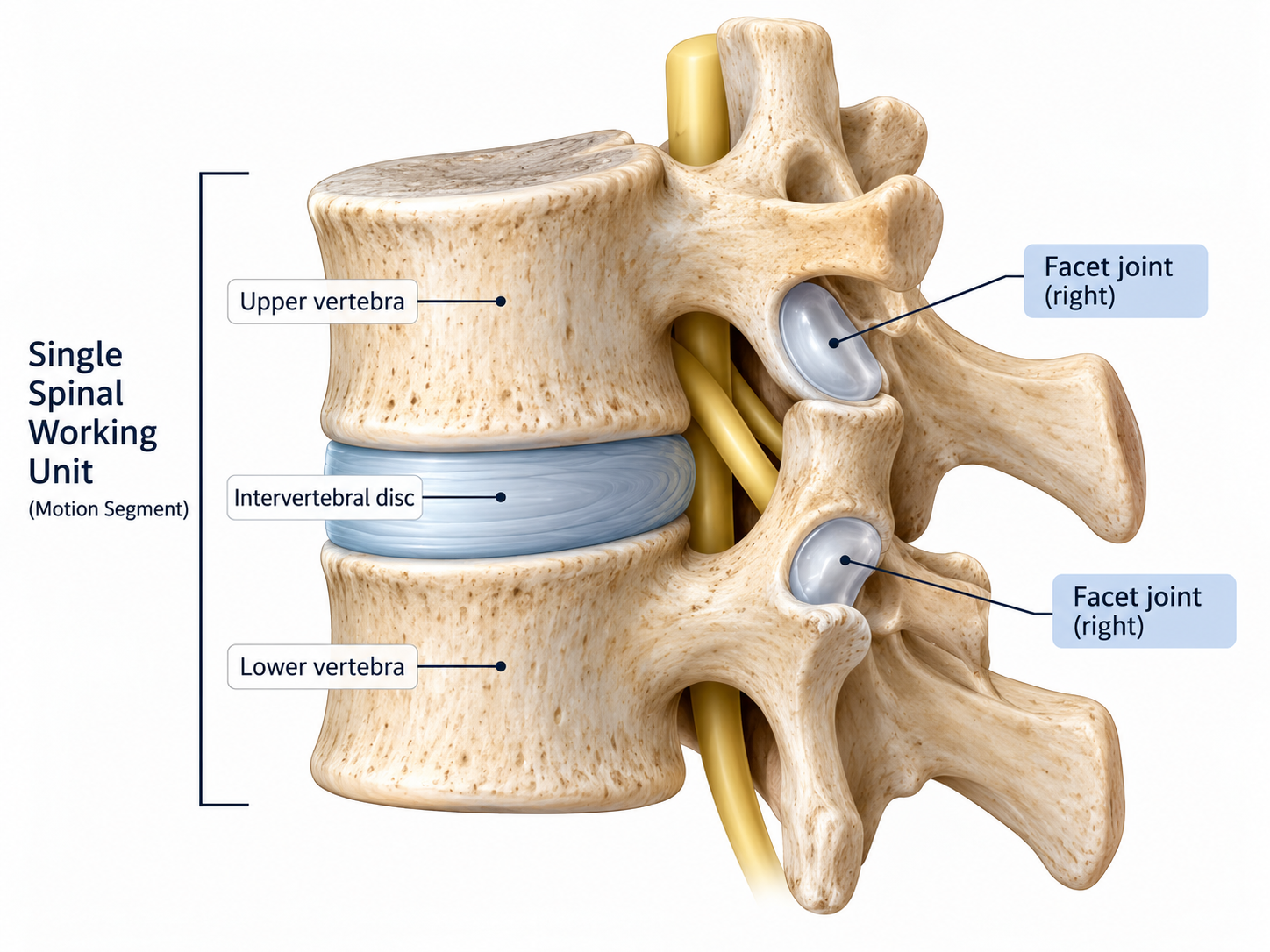
The working unit: nature’s smallest committee
Rather than think about the spine one bone at a time, I find it more useful to think about it two bones at a time. Take any two neighbouring vertebrae, together with the disc that sits between them and the two small facet joints that sit behind them, and you have what I call a working unit (you can explore this in more depth on the Spinal Working Unit page). It’s the basic building block of the whole spine, and it’s a genuinely elegant piece of engineering — three joints sharing one job, front and back, so that no single structure ever has to carry the whole load alone.
That sharing matters enormously for how you understand your own back pain. A working unit doesn’t usually fail because one part gave out in isolation. It fails as a unit — the disc loses a little height, so the facet joints behind it take more load than they’re used to, so they start to ache under stress they were never quite designed to carry alone. Almost every case of “wear and tear” I see in clinic is this same story, just at a different stage.
The disc: a jelly doughnut that doesn’t “slip”
The disc between each pair of vertebrae is made of a tough, fibrous outer ring (the annulus) wrapped around a softer, more gel-like centre (the nucleus). I often describe it to patients as a jelly doughnut, and unlike a lot of the shorthand doctors use, this one genuinely holds up. The tough ring behaves like the dough, and the softer centre behaves like the jelly. If the ring develops a weak spot, the jelly can genuinely press through it, in much the same way the filling escapes a doughnut with a split in its side.
You’ll also hear people talk about a “slipped disc.” It’s a phrase that has stuck around because it’s vivid, but discs don’t slip. They’re anchored firmly to the vertebrae above and below, and they can’t come loose or move out of place the way the name suggests. What I’ve just described, the jelly pressing through a weak spot in the ring, has a proper name, a disc prolapse (you can read more on the disc prolapse condition page). That’s a very different, and far less frightening, mechanical event than “slipping.”
It’s also worth saying plainly: discs dry out and lose a little height as you get older, and that is normal. An MRI scan taken of almost any pain-free 50-year-old will show some of this “degeneration.” Seeing that word on a scan report is one of the most common reasons patients arrive in my clinic worried — but ageing discs, on their own, are not a diagnosis. They’re just what a spine looks like after it’s been used for fifty years.
The facet joints: the roof tiles of the spine
Behind each disc sit two small, interlocking joints called facet joints, one on either side. I think of them as roof tiles — angled, overlapping surfaces that guide movement in the directions your back is supposed to bend, and quietly block it in the directions it isn’t. They’re what stops a simple forward bend from twisting your spine into something dangerous.
Like any joint that moves for decades, facet joints can wear. When they do, the pain they cause tends to sit close to the spine itself, often eases with rest, and often worsens with standing or arching backwards — a pattern that’s genuinely useful for working out what’s going on, and one I pay close attention to at a first consultation.
The motorway: why pain rarely stays where the problem is
Running down the middle of that stack of working units is the spinal cord, and at each level a pair of nerve roots branches off it to reach the rest of your body — down an arm, around a rib, down a leg to the toes. I think of this whole network as a motorway: a main carriageway with junctions and slip roads at every level, each one signposted to a different part of the body (this is the idea behind the Spinal Motorway page, which goes into it properly).
This is also the single most important thing to understand about back pain, and the part patients find most surprising: where something is pinching or irritating a nerve root, and where you feel the pain, are very often two completely different places. Irritate the nerve root that exits low in your back, and you may feel almost nothing in your back at all — instead, it can travel down the back of your leg, all the way to your foot. That’s sciatica (there’s a full explanation on the lower back pain symptom page), and it’s a good example of the motorway at work. The irritation doesn’t have to be sitting right at the junction either. It can just as easily be further along, on one of the smaller A roads or B roads the nerve travels on its way down your leg, with the traffic jam still turning up a long way from where the actual fault lies.
That’s also why I’m cautious about drawing firm conclusions from where a patient points when they describe their pain, and why I lean instead on how the pain behaves — what brings it on, what eases it, whether it travels, whether it’s accompanied by numbness or weakness. The location of the discomfort is a clue, not a verdict.
Why this picture actually helps
None of this is complicated once it’s laid out. A spine is a long chain of small, shared-load joints, wrapped around a signalling network with junctions at every level. Most of what goes wrong follows directly from that: a working unit taking more strain than it’s built for, a disc’s outer ring developing a weak point, a facet joint stiffening with age, a nerve root getting irritated somewhere along its route, at the junction or further out along an A road or B road, with the pain often felt some distance from where the actual problem is.
I find that patients who leave a consultation with this picture in their head — rather than just a diagnosis on a piece of paper — cope with the whole experience differently. It stops feeling like something mysterious is happening inside you, and starts feeling like a specific, understandable mechanical problem, in a specific place, with options attached to it.
If you’d like to go further, the Spinal Working Unit and Spinal Motorway pages walk through both ideas interactively, in more anatomical detail than fits naturally into an article. And if something in this description sounds like what you’re feeling — particularly pain that travels, or changes with position — the symptoms section is a good next stop.
Take the next step
Ready to talk it through?
Speak with Mr. Rath about your diagnosis and treatment options.
Book Appointment